
RV Camping in the American Southwest: A Practical Route Guide
Timing, routes, and what to actually pack — for the trip out of Las Vegas
The American Southwest is one of those places that makes more sense from inside an RV than from anywhere else. The distances are long, the campgrounds are spread out, and the landscapes change every hundred miles — Mojave scrub into red canyon walls into pine forest into Sonoran desert floor. A car-camping trip in canyon country means hauling everything in and out each day. An RV trip means you carry your kitchen, your bed, and your shade with you, and the Southwest rewards that enormously.

If you're based in or flying into Las Vegas, you're already positioned at one of the best RV launch points in the country. Within a three-hour radius: Valley of Fire, Zion National Park, Death Valley, the Mojave National Preserve, and the Arizona high desert corridor toward Sedona. Here's how to approach that geography practically, with the season windows and gear that actually matter.
The October–April Window (and Why It Exists)
The Southwest's elevation range is what makes seasonal planning complicated and what makes it genuinely worth learning.
At low elevations — the Las Vegas valley floor, Furnace Creek in Death Valley, Phoenix, the lower Colorado River — summer is genuinely dangerous for RV travel. Ground temperatures exceed 160°F in direct sun. Rubber roof seals and slide-out seals degrade faster in sustained 115°F ambient heat. Most importantly, the human body can't cool itself efficiently at those temperatures, and shade is the only partial solution.
The exception is elevation. Sedona, Arizona sits at 4,500 feet — summer highs are in the low 90s, manageable. Flagstaff is at 7,000 feet and has cool nights year-round. Utah's Zion corridor runs from 3,700 feet at the canyon floor up to 8,000+ on the plateau — warm summers but not lethal. These high-country destinations open up options through the summer months, but they also get cold and sometimes snowy in January and February.
For low-elevation Southwest RV camping, the practical window is October 15 through April 15. The valleys are warm but not dangerous, desert wildflowers peak in February and March, and campgrounds that are booked out completely in April start opening up slots in October and November. The absolute sweet spot is mid-October through mid-November and February through mid-March — before spring break crowds hit Zion and Sedona.
One note on spring: the Mojave and the Utah canyons get significant wind from March through May, often 40–60 mph sustained. Wind at elevation in canyon country is uncomfortable and can be dangerous for high-profile rigs. If you're driving anything over 36 feet, or towing a high fifth wheel, check the wind forecast before routing through open plateau country in spring.
Four Zones to Plan Around
The Mojave / Nevada corridor runs roughly west from Las Vegas toward Barstow, California, and northwest toward the Spring Mountains. Elevation is low (below 3,000 feet in most of the valley floor). This is the zone that's completely off-limits June through September and excellent November through February.
Arizona's Sonoran Desert — Phoenix, Tucson, the lower Verde Valley — is in a similar elevation band. October through April is the window. The Sonoran has more biological diversity than the Mojave (saguaro cacti don't grow in Nevada), and the city infrastructure around Phoenix and Tucson makes longer stays easier: dump stations, propane, water fill, grocery stores between campsites.
Utah canyon country — Zion, Bryce Canyon, Capitol Reef, the Grand Staircase — runs from roughly 3,700 to 8,000 feet. Summers are hot at the bottom of Zion Canyon but not dangerous. The shoulder seasons (April–May and September–October) are the sweet spot for crowds and weather. Bryce and Capitol Reef get road closures and ice through March.
The high-elevation transition zone is the least-known but often the most comfortable: Sedona, Jerome, Prescott, and the Mogollon Rim in Arizona all sit between 4,000 and 6,500 feet. You can camp here comfortably in July at temperatures 30 degrees lower than Phoenix. These areas make good pivot points when the valley floor is too hot to camp.
Routes Out of Las Vegas
Valley of Fire (55 miles northeast, ~1 hour)
Nevada's oldest state park, and the one most people from Las Vegas have never actually camped in. The Aztec sandstone formations turn deep red in morning and evening light, and the roads through the park are genuinely drivable in most RV configurations. Atlatl Rock Campground and Arch Rock Campground are the two options — both are hookup-free, so this is a 1–2 night water-tank-and-generator trip, not a long-stay site. The park gets busy on weekends October through March. Come midweek or arrive by 8 AM on weekends.
The Zion corridor (160 miles northeast, ~2.5 hours)
The campgrounds inside Zion — South Campground and Watchman Campground — require reservations months in advance for spring and fall weekends. If you can't get a site in the park, the town of Hurricane (12 miles west on UT-9) has several RV parks with full hookups and easy access to the park via shuttle. The drive through the Zion–Mount Carmel Tunnel requires an escort for vehicles over 11'4" wide or 13'1" tall — check NPS requirements for your rig before routing through.
Death Valley in season (130 miles west, ~2 hours)
Furnace Creek Campground has hookup sites and is the only option in the park with amenities — book months ahead for November through February. The rest of the park's campgrounds are first-come, first-served and dry (no hookups). If you go in January or February, plan for nights in the 40s and days in the 70s. That's the best possible window for the park. Do not route through Death Valley after mid-April.
Mojave National Preserve (95 miles south via I-15, ~1.5 hours)
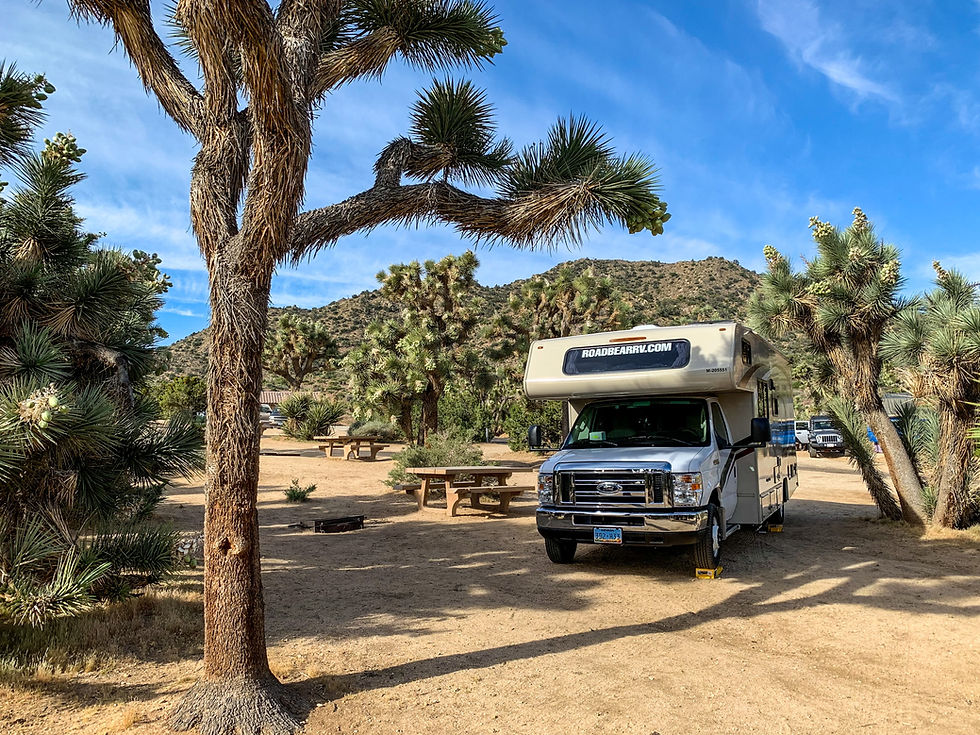
The Mojave Preserve covers nearly 1.6 million acres of cinder cones, lava tubes, Joshua tree forests, and sand dunes. Hole-in-the-Wall Campground is the main developed site — 35 sites, some with hookups, and a genuine sense of solitude that Zion can't offer in season. Mid-October through March is the reliable window. Cell service is limited throughout.

The Gear That Actually Matters Out Here
A lot of what works for camping in the Pacific Northwest or the Southeast will leave you short out here. Desert RV camping has a few specific requirements that standard camping kits don't account for.
Water is the first variable. Dry campsites — no hookups — are common in the Southwest. Know your rig's fresh water tank capacity and plan around it. At a dry site in warm weather, a two-person rig goes through 10–15 gallons per day for showers, cooking, and drinking. Extra collapsible water containers give you a buffer between dump stations and water fill points, which can be 50+ miles apart in the Mojave and Preserve areas.
Thermal window shades matter more than you expect. In a stationary RV in direct desert sun, interior temperatures can climb 30–40°F above ambient if the windows aren't covered. Reflective shades — the kind you prop in a car windshield — work for smaller windows. For larger rigs, aftermarket insulating shades make a real difference in how hard your AC has to work.
A tire pressure monitoring system is worth installing before a Southwest trip. Pavement temperatures in the Mojave regularly hit 165°F, and underinflated tires fail much faster at those temperatures. Check pressure every morning before driving.
Cold nights surprise people. Desert campsites at 3,000–5,000 feet drop to the 30s and 40s in October and November even when days are warm. A portable propane heater or a well-tested electric heater (if you have shore power) prevents the common mistake of camping with a rig whose furnace hasn't been serviced since the previous winter.
Hiking boots, not trail runners. Desert rock is sharp, uneven, and punishing on light footwear. If you're planning to hike at Valley of Fire, the Angels Landing approach at Zion, or anywhere in the Grand Canyon rim area, proper hiking boots matter.
If you're flying into Las Vegas and picking up or renting an RV locally, it's worth stopping at Basecamp Outdoor Gear before you head out. They rent and sell gear in Las Vegas — useful for filling in the trip kit you couldn't check on the plane: extra water containers, coolers, trekking poles, headlamps, etc. Renting rather than buying makes sense for one-off desert trips.

Finding Parks Along the Route
The campgrounds inside the national parks book out fast for fall and spring weekends, but there are dozens of independent RV parks along every corridor — in Mesquite (NV), Kanab (UT), Kingman (AZ), and throughout the Phoenix metro area. Sites like RVSpot let you find RV parks along your route with direct owner contact — the directory covers 10,200+ active parks nationwide, lists hookup availability and site type, and connects you directly to the park rather than routing through a booking intermediary. Free to browse, no reservation fees.
For Southwest-specific planning, call the park before you book. Rig fit (site length, hookup type, pull-through availability), generator hours, and whether the park fills on holiday weekends are all worth confirming directly. It's a five-minute call that prevents a three-hour drive to an incompatible site.
Before You Go
The Southwest doesn't punish mistakes gently — but if you go prepared, it's one of the most memorable trips you can make in an RV. Enough water, proper tire maintenance, a well-stocked first-aid kit, and respect for the seasonal windows will keep you safe and let the landscapes do what they're supposed to do: make you understand why people come out here once and rearrange their life to keep coming back.
About the Author:
Renato Bryant is the founder of RVSpot.net, a free directory of 10,200+ RV parks across the US where travelers find campgrounds and contact park owners directly — no booking fees, no middleman. Based in Panama City, he built RVSpot to solve the problem he kept hearing from full-timers: too many platforms, not enough straight answers.


Comments